

|
|||||
|
OsteoporosisSWITCH OF PRODUCTION- limited availability!
According to the World Health Organization (WHO), osteoporosis ranks fourth place among noninfectious pathologies after cardiovascular disorders, cancer and diabetes mellitus. Osteoporosis (OP) is a common multifactorial disease characterized by progressive decrease of bone mineral density (BMD), reduced bone weight (BW) and deteriorating micro architecture of trabecules, accompanied by increased risk of bone fractures. Osteoporosis is dangerous because quite often it arises and long time progresses in latent form and is diagnosed only after crisis. Osteoporosis affects ca. 75 million people in Europe, USA and Japan. For year 2000, there occur ca. 9 million new cases of osteoporotic fractures, of which 1.6 million are hip fractures, 1.7 million are forearm and 1.4 million clinical vertebral fractures. Europe and both Americas accounted for 51% of all these fractures, while most of the rest occurred in the Western Pacific region and Southeast Asia. Osteoporosis is a typical multifactor disease, that arises from interaction of hereditary (genetic) factors and adverse environmental conditions. Principle of methodAssay principle is based on simultaneous detection of polymorphisms in VDR and Col1A1 genes by means of multiplex PCR with subsequent restriction and polyacrylamide gel electrophoresis. Simultaneous detection of 4 SNPs:
Kit characteristicsGeneral procedure:
Investigated material: DNA sample
Quantity of reactions: 100 (40 patient samples) Time:
Storage conditions: -18 °С – -22 °С Shelf life: 6 months |
||||


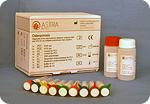 Diagnostic kit for estimating of genetic predisposition to osteoporosis.